ABG Interpretation & Acid–Base Balance
🎧 Audio overview
📝 Quick notes
Exam-oriented notes for RRB Nursing Superintendent / NORCET. Based on standard adult arterial blood gas (ABG) reference ranges used in Brunner & Suddarth and Potter & Perry.
1. Normal ABG Values (Arterial)
| Parameter | Normal range | Unit |
|---|---|---|
| pH | 7.35 – 7.45 | — |
| PaCO₂ | 35 – 45 | mmHg |
| HCO₃⁻ | 22 – 26 | mEq/L (mmol/L) |
| PaO₂ | 80 – 100 | mmHg |
| SaO₂ | ≥ 95 | % |
| Base excess (BE) | −2 to +2 | mEq/L |
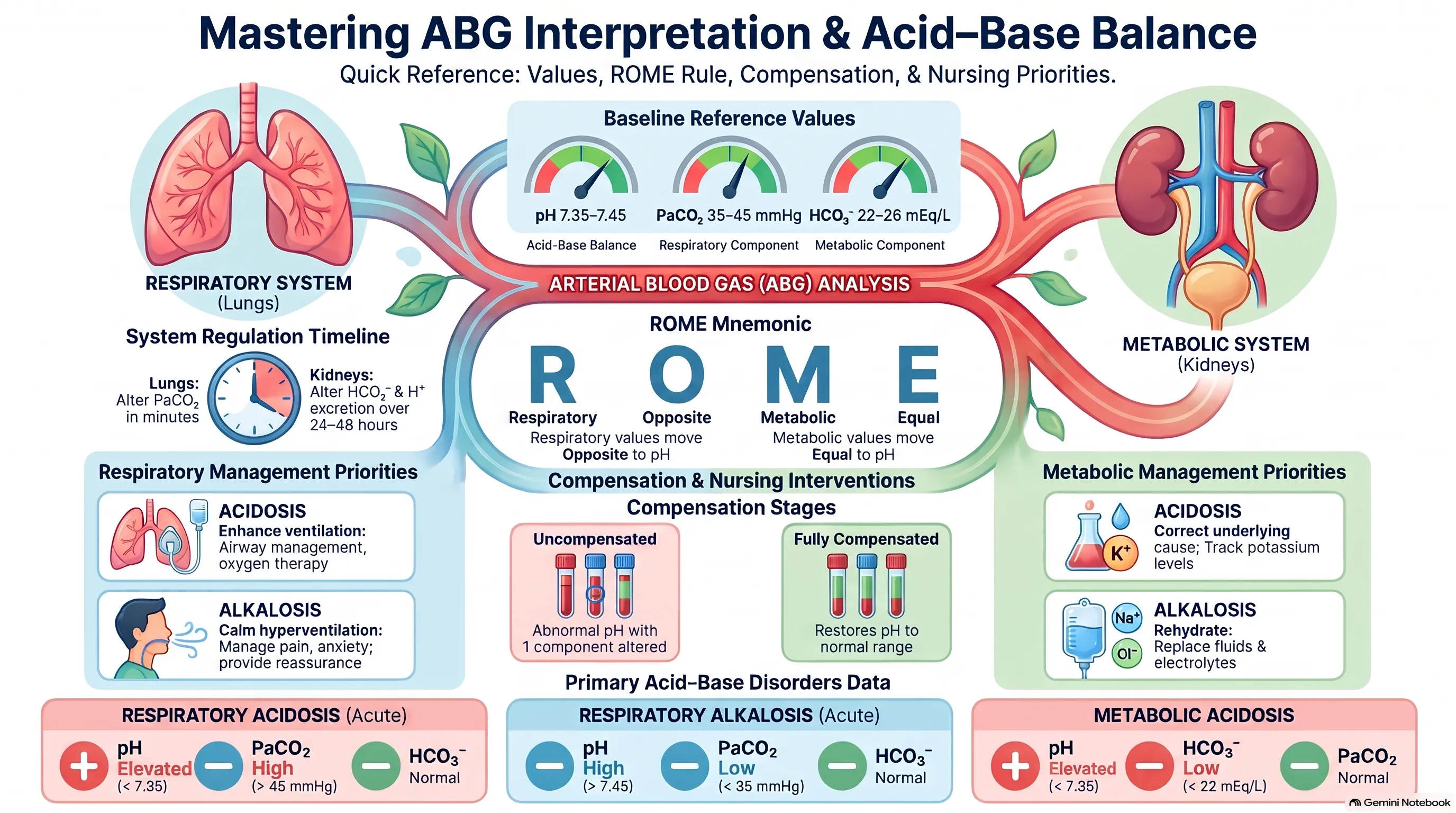
Memory aids - Acidosis: pH below 7.35 - Alkalosis: pH above 7.45 - PaCO₂ is the respiratory component (controlled by lungs) - HCO₃⁻ is the metabolic component (controlled by kidneys)
Note for exams: Some Indian MCQ banks list HCO₃⁻ as 22–28 mEq/L. Prefer 22–26 unless the question stem gives another range. PaO₂ and SaO₂ assess oxygenation, not acid–base primary disturbance.
2. Components of Acid–Base Balance
- pH: Reflects hydrogen ion (H⁺) concentration. Small change in pH means large change in H⁺.
- Buffers: Blood buffers (bicarbonate–carbonic acid, haemoglobin, plasma proteins, phosphate) act within seconds.
- Respiratory regulation: Lungs alter PaCO₂ by changing rate and depth of breathing (minutes).
- Renal regulation: Kidneys reabsorb or excrete HCO₃⁻ and H⁺ (hours to days).
Ratio of HCO₃⁻ : dissolved CO₂ is normally about 20 : 1 (Henderson–Hasselbalch).
3. Four Primary Disturbances
| Disorder | pH | PaCO₂ | HCO₃⁻ |
|---|---|---|---|
| Respiratory acidosis | ↓ | ↑ | Normal (acute) |
| Respiratory alkalosis | ↑ | ↓ | Normal (acute) |
| Metabolic acidosis | ↓ | Normal (acute) | ↓ |
| Metabolic alkalosis | ↑ | Normal (acute) | ↑ |
Common causes (high-yield)
- Respiratory acidosis: Hypoventilation — COPD, opioid overdose, chest trauma, neuromuscular disease, airway obstruction.
- Respiratory alkalosis: Hyperventilation — anxiety, pain, high altitude, early sepsis, salicylate early phase, mechanical overventilation.
- Metabolic acidosis: Diabetic ketoacidosis (DKA), lactic acidosis, renal failure, diarrhoea (loss of HCO₃⁻), starvation.
- Metabolic alkalosis: Vomiting, nasogastric suction, diuretic therapy, excess alkali intake, hypokalaemia.
4. ROME Rule
ROME = Respiratory Opposite, Metabolic Equal
- Respiratory Opposite: pH and PaCO₂ move in opposite directions.
- ↓ pH + ↑ PaCO₂ → respiratory acidosis
- ↑ pH + ↓ PaCO₂ → respiratory alkalosis
- Metabolic Equal: pH and HCO₃⁻ move in the same direction.
- ↓ pH + ↓ HCO₃⁻ → metabolic acidosis
- ↑ pH + ↑ HCO₃⁻ → metabolic alkalosis
Use ROME after checking pH first, then match the component that “agrees” with the pH change.
5. Stepwise ABG Interpretation (Exam Method)
- Look at pH → acidosis, alkalosis, or normal.
- Look at PaCO₂ → if abnormal in the direction that explains pH → respiratory.
- Look at HCO₃⁻ → if abnormal in the direction that explains pH → metabolic.
- Check for compensation (see below).
- Check PaO₂ / SaO₂ for hypoxaemia (separate from acid–base type).
If both PaCO₂ and HCO₃⁻ are abnormal and pH is still abnormal → partial compensation. If pH is normal but both components are abnormal → full compensation (pH may sit on the side of the primary disorder).
6. Compensation
| Stage | pH | Primary component | Compensating component |
|---|---|---|---|
| Uncompensated | Abnormal | Abnormal | Normal |
| Partially compensated | Abnormal | Abnormal | Abnormal (moving to correct pH) |
| Fully compensated | Normal (or near normal) | Abnormal | Abnormal |
How compensation works - Respiratory acidosis → kidneys retain HCO₃⁻ (↑ HCO₃⁻). - Respiratory alkalosis → kidneys excrete HCO₃⁻ (↓ HCO₃⁻). - Metabolic acidosis → lungs hyperventilate (↓ PaCO₂) — Kussmaul breathing in DKA. - Metabolic alkalosis → lungs hypoventilate (↑ PaCO₂) — limited by hypoxia drive.
Lungs compensate within minutes; kidneys take 24–48 hours or more for full effect.
7. Worked Examples
Example A
pH 7.28, PaCO₂ 58 mmHg, HCO₃⁻ 24 mEq/L
- pH low → acidosis
- PaCO₂ high, HCO₃⁻ normal → uncompensated respiratory acidosis
Example B
pH 7.50, PaCO₂ 30 mmHg, HCO₃⁻ 22 mEq/L
- pH high → alkalosis
- PaCO₂ low, HCO₃⁻ normal → uncompensated respiratory alkalosis
Example C
pH 7.30, PaCO₂ 36 mmHg, HCO₃⁻ 16 mEq/L
- pH low → acidosis
- HCO₃⁻ low, PaCO₂ normal → uncompensated metabolic acidosis
Example D
pH 7.32, PaCO₂ 30 mmHg, HCO₃⁻ 15 mEq/L
- pH low → acidosis
- HCO₃⁻ low (primary metabolic acidosis); PaCO₂ also low (respiratory compensation) → partially compensated metabolic acidosis
Example E
pH 7.40, PaCO₂ 60 mmHg, HCO₃⁻ 36 mEq/L
- pH normal; both PaCO₂ and HCO₃⁻ high → fully compensated respiratory acidosis (chronic COPD pattern often fits this)
Example F
pH 7.48, PaCO₂ 46 mmHg, HCO₃⁻ 32 mEq/L
- pH high → alkalosis
- HCO₃⁻ high (metabolic); PaCO₂ slightly high (compensation) → partially compensated metabolic alkalosis
8. Mixed Disturbances (Brief)
Both systems may be disordered at once (e.g., cardiac arrest: respiratory and metabolic acidosis). Suspect mixed disorder when compensation is “too much” or “too little” for the expected response, or when clinical history suggests dual causes. Exact quantitative expected-compensation formulas are beyond most nursing MCQ needs; focus on history plus the three-step ABG read.
9. Nursing Priorities Linked to ABG
- Respiratory acidosis: improve ventilation — airway, oxygen as ordered, reverse sedation if indicated, assist cough/suction, prepare for mechanical ventilation if worsening.
- Respiratory alkalosis: calm breathing, treat pain/anxiety/hypoxia cause; paper-bag rebreathing only if instructed and hypoxia excluded.
- Metabolic acidosis: treat cause (fluids/insulin in DKA, improve perfusion in shock); monitor potassium (often high in acidosis, falls with correction).
- Metabolic alkalosis: replace fluid/electrolytes as ordered; antiemetics; careful diuretic review.
- Always correlate ABG with SpO₂, respiratory rate, level of consciousness, and electrolytes.
10. Quick Exam Checklist
- Memorise normals: pH 7.35–7.45, PaCO₂ 35–45, HCO₃⁻ 22–26.
- Apply ROME.
- State compensation stage clearly.
- Link cause → nursing action in one line when asked.
References
- Hinkle JL, Cheever KH. Brunner & Suddarth’s Textbook of Medical-Surgical Nursing. Wolters Kluwer. Chapters on fluid, electrolyte, and acid–base balance; respiratory care.
- Potter PA, Perry AG, et al. Fundamentals of Nursing. Elsevier. Chapters on oxygenation and fluid/electrolyte/acid–base balance.
- Standard Indian nursing council / exam reference ranges as used in NORCET and RRB Nursing Superintendent MCQs (align with values above).